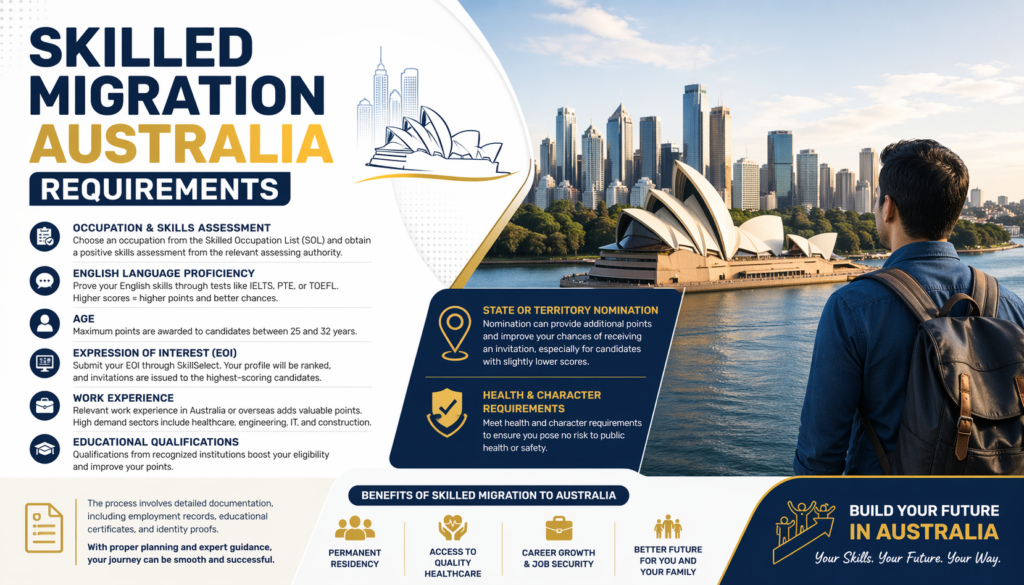
Australia’s skilled migration program is one of the most structured and sought-after immigration pathways globally, designed to attract professionals who can contribute to the country’s economy. The system operates on a points-based framework, where applicants are evaluated based on age, educational qualifications, work experience, English language proficiency, and other factors.
To begin with, candidates must choose an occupation from the Skilled Occupation List (SOL) and ensure that their profession aligns with Australia’s labor market demands. A positive skills assessment from a relevant assessing authority is mandatory, confirming that the applicant’s qualifications and experience meet Australian standards.
One of the core requirements for skilled migration is English language proficiency, typically demonstrated through tests such as IELTS, PTE, or TOEFL. Higher scores significantly improve an applicant’s points, enhancing the chances of receiving an invitation to apply.
Age also plays a crucial role, with maximum points awarded to candidates between 25 and 32 years. Additionally, applicants must submit an Expression of Interest (EOI) through the SkillSelect system, where their profile is ranked against others. Invitations are issued periodically, and only candidates with competitive scores are selected.
Work experience, both within Australia and internationally, adds substantial value to an application. Candidates with several years of relevant professional experience gain higher points, especially if their expertise is in high-demand sectors such as healthcare, engineering, IT, and construction.
Educational qualifications, particularly those obtained from recognized institutions, further strengthen eligibility. In some cases, state or territory nomination can provide additional points and increase the likelihood of securing a visa, especially for applicants with slightly lower scores.
Apart from meeting the points threshold, applicants must satisfy health and character requirements, ensuring they pose no risk to public health or safety. The process also involves submitting detailed documentation, including employment records, educational certificates, and identity proofs.
While the procedure may seem complex, proper planning and professional guidance can significantly streamline the journey. Skilled migration to Australia offers long-term benefits, including permanent residency, access to healthcare, and opportunities for career growth, making it an attractive option for qualified professionals worldwide.